
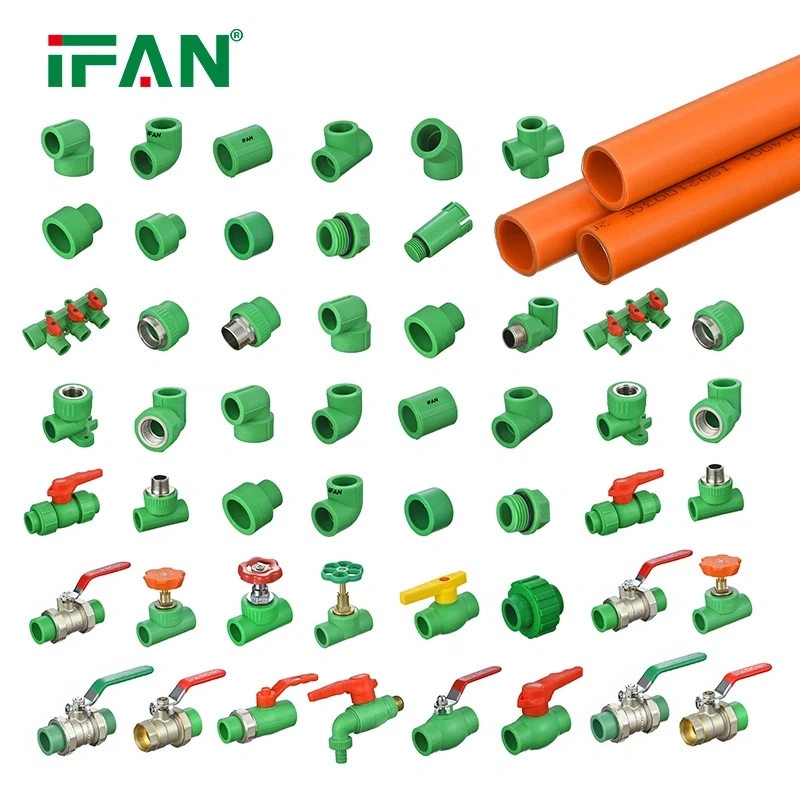
PPR Plumbing Fitting Supplier
How PPR Pipe Fittings Achieve Stable Performance Under Cyclic Pressure
Cyclic Pressure as a Design Challenge
In real operating conditions, water supply and heating systems rarely function under constant pressure. Pumps starting and stopping, valve operation, and changes in demand create repeated pressure fluctuations known as cyclic pressure. These cycles place continuous mechanical stress on pipe fittings and joints. PPR pipe fittings are specifically engineered to withstand such conditions, maintaining stable performance and structural integrity over long service periods.

Molecular Flexibility and Stress Absorption
The ability of PPR fittings to handle cyclic pressure begins with the material's molecular structure. PPR features a random copolymer arrangement that combines strength with flexibility. This structure allows the material to absorb repeated pressure changes without becoming brittle. When pressure rises and falls, stress is distributed through molecular chain movement rather than concentrated at a single point, reducing the risk of fatigue-related damage.
Optimized Geometry for Even Stress Distribution
Modern PPR pipe fittings are designed with smooth internal contours, consistent wall thickness, and reinforced critical zones. These geometric features help distribute internal pressure evenly across the fitting body. By minimizing stress concentration, the fitting avoids localized overstress during each pressure cycle. This optimized design plays a key role in maintaining mechanical stability under long-term cyclic loading.
Precision Manufacturing and Residual Stress Control
Manufacturing quality has a direct impact on performance under cyclic pressure. Advanced injection molding techniques ensure uniform material flow and controlled cooling, which reduce residual internal stress. Lower residual stress means the fitting starts its service life in a more relaxed structural state, making it better able to tolerate repeated pressure changes without crack initiation or deformation.
Heat Fusion Joints and Pressure Continuity
Heat fusion joining creates a continuous material connection between the pipe and fitting. This continuity eliminates mechanical interfaces that could act as stress concentrators during pressure cycling. When pressure fluctuates, stress transfers smoothly across the joint, allowing the fused connection to perform as an integral part of the piping system. This seamless stress transfer supports long-term joint stability under cyclic pressure.
Resistance to Fatigue and Long-Term Deformation
Cyclic pressure can gradually lead to fatigue or creep if the material lacks sufficient resistance. PPR demonstrates strong fatigue resistance and controlled creep behavior within typical operating temperature and pressure ranges. These properties allow fittings to maintain dimensional stability and pressure rating over time, even when exposed to frequent pressure variations.
Reliable Performance in Practical Applications
Through molecular flexibility, optimized design, precise manufacturing, and reliable fusion joints, PPR pipe fittings achieve stable performance under cyclic pressure. These characteristics ensure dependable operation, reduced maintenance risk, and extended service life, making PPR fittings a reliable solution for modern water supply and heating systems.
Hot Tags: ppr plumbing fitting supplier, China, suppliers, manufacturers, factory, wholesale, cheap, discount, low price, in stock, free sample, PPR Fitting Cap, PPR Fitting Elbow, PPR Fitting Plug, PPR Fitting Socket, PPR Fitting Tee, Pure PPR Fitting
Send Inquiry
