
IFAN factory 30+ years manufacture experience support color /size customization support free sample.Welcome to consult for catalog and free samples.This is our Facebook Website:www.facebook.com,Click to watch IFAN's product video.Compared with Tomex products, our IFAN products from quality to price are your best choice, welcome to buy!
Extrusion Molding Process of HDPE Pipe Fittings
Introduction
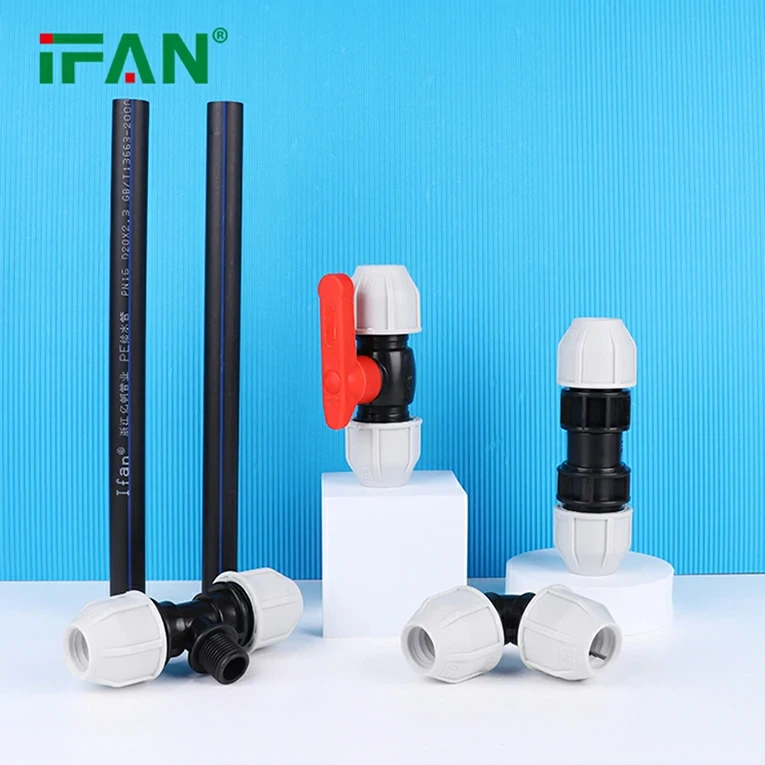
High - Density Polyethylene (HDPE) is a widely used thermoplastic material renowned for its excellent mechanical properties, chemical resistance, and durability. HDPE pipe fittings play a crucial role in various industries, including water supply, drainage, gas distribution, and industrial fluid transportation. The extrusion molding process is a fundamental manufacturing method for producing HDPE pipe fittings, enabling the creation of consistent, high - quality products with precise dimensions. This article delves into the detailed steps, key considerations, and important aspects of the extrusion molding process for HDPE pipe fittings.
Raw Material Preparation
Selection of HDPE Resin
The quality of HDPE pipe fittings largely depends on the selection of the raw material, the HDPE resin. Different grades of HDPE resins are available, each with specific properties tailored to various applications. For pipe fittings, resins with high melt strength, good impact resistance, and excellent long - term hydrostatic strength are preferred. These properties ensure that the resulting pipe fittings can withstand the internal pressure of fluids, external mechanical loads, and environmental factors over an extended period. Manufacturers carefully choose the resin grade based on the intended use of the pipe fittings, such as whether they will be used for high - pressure water supply or sewage drainage.
Drying and Pre - treatment
Before extrusion, the HDPE resin pellets need to be properly dried to remove any moisture. Moisture in the resin can cause defects in the final product, such as bubbles, voids, or surface imperfections. The resin is typically dried in a hopper dryer at a specific temperature and for a set duration, usually ranging from 2 to 4 hours at temperatures between 70°C and 90°C. In some cases, additional pre - treatment steps may be involved, such as adding additives like antioxidants, UV stabilizers, or colorants. These additives can enhance the performance and appearance of the HDPE pipe fittings, protecting them from oxidation, ultraviolet degradation, or enabling color - coding for different applications.
Extrusion Molding Process Steps
Feeding the Resin
The dried and pre - treated HDPE resin pellets are fed into the hopper of the extruder. The hopper acts as a storage container, supplying a continuous and regulated flow of resin to the extruder screw. The feeding rate is carefully controlled to ensure a steady production process and to maintain the quality of the extruded product. Some extruders are equipped with gravimetric or volumetric feeders that accurately measure and control the amount of resin being fed, ensuring consistent product dimensions and quality.
Melting and Mixing in the Extruder
Inside the extruder barrel, the HDPE resin is heated and gradually melted by the combination of external heating elements and the mechanical action of the screw. The extruder screw, with its unique design of flights and channels, conveys the resin forward while simultaneously mixing and shearing it. This process ensures uniform melting and blending of the resin, as well as the dispersion of any added additives. The temperature profile along the extruder barrel is carefully set, with different zones having specific temperature settings. Typically, the temperature increases from the feeding zone to the die end, reaching a peak in the melting and metering zones, usually in the range of 180°C to 230°C, depending on the type of HDPE resin and the requirements of the product.
Shaping through the Die
Once the HDPE resin is fully melted and uniformly mixed, it is forced through the die, which is the component that gives the extruded product its final shape. For HDPE pipe fittings, different dies are used depending on the specific fitting type, such as elbows, tees, or couplings. The die has a precisely designed internal geometry that determines the outer diameter, wall thickness, and other dimensions of the pipe fitting. As the molten resin passes through the die, it is shaped into the desired form. The die is usually cooled to control the solidification rate of the resin, ensuring that the pipe fitting maintains its shape and dimensional accuracy as it exits the die.
Cooling and Solidification
After exiting the die, the extruded HDPE pipe fitting enters the cooling system. The cooling process is crucial for rapidly solidifying the molten resin and maintaining the shape and dimensional stability of the product. Cooling is typically achieved through a combination of water baths and air cooling. The pipe fitting is first passed through a water - filled tank or a series of water - cooled troughs, where the rapid heat transfer from the hot resin to the cold water causes it to solidify quickly. 随后,air blowers may be used to further cool the product and remove any remaining moisture. Proper cooling is essential to prevent warping, distortion, or internal stresses in the pipe fitting, which could affect its mechanical properties and performance.
Cutting and Post - processing
Once the HDPE pipe fitting is fully cooled and solidified, it is cut to the desired length using a cutting device, such as a saw or a cutter. The cutting process is carefully controlled to ensure clean, smooth cut ends. After cutting, some pipe fittings may undergo additional post - processing steps, such as deburring to remove any rough edges, surface finishing to improve the appearance, or heat treatment to enhance the mechanical properties. In some cases, the pipe fittings may also be subjected to quality inspection procedures, including dimensional checks, wall thickness measurements, and non - destructive testing to ensure they meet the required standards and specifications.
Process Parameter Control
Temperature Control
Temperature is one of the most critical parameters in the extrusion molding process of HDPE pipe fittings. As mentioned earlier, the temperature profile along the extruder barrel must be precisely controlled to ensure proper melting, mixing, and shaping of the resin. Deviations from the optimal temperature can lead to various problems, such as poor melt flow, uneven wall thickness, or surface defects. For example, if the temperature is too low, the resin may not melt completely, resulting in lumps or unmelted particles in the final product. On the other hand, if the temperature is too high, the resin may degrade, losing its mechanical properties and causing discoloration. Therefore, advanced temperature control systems, such as thermocouples and temperature controllers, are used to monitor and adjust the temperature in real - time.
Screw Speed
The screw speed in the extruder affects the flow rate of the resin, the mixing efficiency, and the residence time of the resin in the extruder. A higher screw speed increases the flow rate of the resin, but it may also lead to insufficient mixing or excessive shear heat generation, which can degrade the resin. Conversely, a lower screw speed may result in poor melt flow and inconsistent product quality. The optimal screw speed depends on factors such as the type of HDPE resin, the size and design of the extruder, and the requirements of the product. Manufacturers often conduct trials and experiments to determine the best screw speed for a particular production run.
Die Pressure
The pressure within the die is another important parameter that influences the shape, dimensions, and quality of the HDPE pipe fittings. Adequate die pressure is required to ensure that the molten resin fills the die cavity completely and maintains the desired shape as it exits the die. If the die pressure is too low, the pipe fitting may have thin walls, irregular shapes, or incomplete filling. On the other hand, excessive die pressure can cause excessive stress on the die and the extruder, leading to wear and tear or even damage to the equipment. Die pressure is controlled by adjusting factors such as the screw speed, the temperature of the resin, and the geometry of the die.
Common Problems and Solutions
Surface Defects
Surface defects, such as roughness, bubbles, or streaks, are common issues in the extrusion molding of HDPE pipe fittings. These defects can be caused by factors such as moisture in the resin, improper mixing, or incorrect die design. To address these problems, ensuring proper resin drying, optimizing the mixing process in the extruder, and inspecting and modifying the die if necessary can be effective solutions. For example, if bubbles are present, it may indicate that the resin was not dried thoroughly, and increasing the drying time or temperature may resolve the issue.
Dimensional Inaccuracies
Dimensional inaccuracies, such as variations in outer diameter, wall thickness, or length, can occur due to factors like fluctuations in process parameters, wear and tear of the die, or improper cooling. To ensure dimensional accuracy, regular calibration of the extruder and the measuring equipment, monitoring and controlling the process parameters closely, and maintaining the die in good condition are essential. If dimensional variations are detected, adjustments to the temperature, screw speed, or die pressure may be required, and the die may need to be repaired or replaced if it is worn out.
Poor Mechanical Properties
Poor mechanical properties, such as low impact resistance or tensile strength, can result from issues such as improper resin selection, incorrect processing conditions, or insufficient cooling. To improve the mechanical properties of HDPE pipe fittings, choosing the right grade of HDPE resin, optimizing the extrusion process parameters, and ensuring proper cooling are crucial. Additionally, adding appropriate additives, such as impact modifiers or reinforcing agents, can enhance the mechanical performance of the final product.

Conclusion
The extrusion molding process of HDPE pipe fittings is a complex and precise manufacturing method that requires careful control of various factors, from raw material preparation to process parameter adjustment. By understanding the detailed steps, key considerations, and potential problems associated with this process, manufacturers can produce high - quality HDPE pipe fittings that meet the stringent requirements of different industries. Continued research and development in extrusion technology, along with improvements in material science, will further enhance the efficiency and quality of the extrusion molding process for HDPE pipe fittings, enabling the production of more advanced and reliable products in the future.