
IFAN factory 30+ years manufacture experience support color /size customization support free sample.Welcome to consult for catalog and free samples.This is our Facebook Website:www.facebook.com,Click to watch IFAN's product video.Compared with Tomex products, our IFAN products from quality to price are your best choice, welcome to buy!
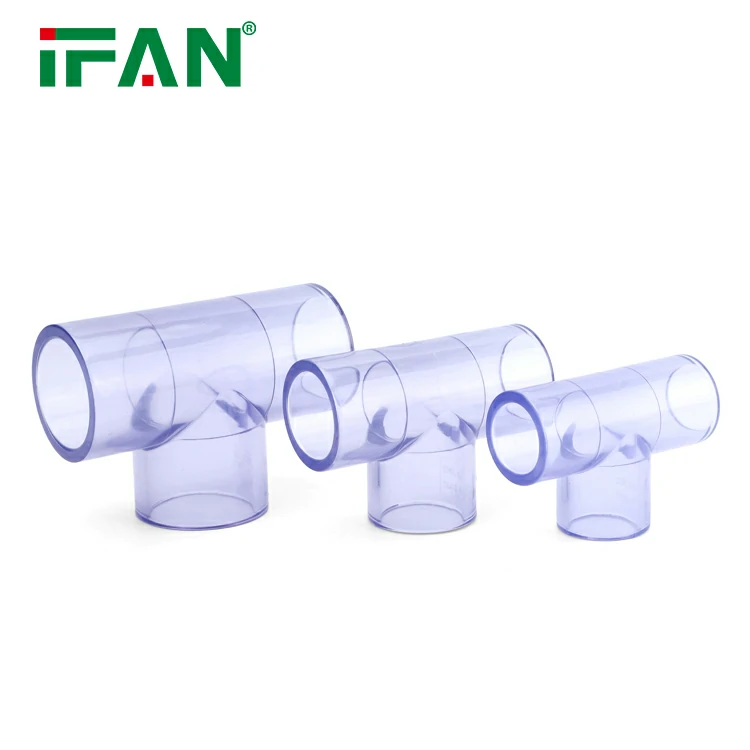
Transparent PVC connectors are widely used in laboratory pipelines, chemical processing systems, aquaculture setups, and industrial monitoring lines where visual flow observation is essential. To ensure reliable system performance, one of the most important quality-control steps is dimensional consistency testing. Even small deviations in size can cause leakage, improper sealing, installation difficulties, or long-term structural weakness. This article explains how dimensional consistency is tested, why it matters, and what benefits it brings to real-world applications.
1. Why Dimensional Accuracy Matters in Transparent PVC Connectors
A transparent PVC connector must meet strict dimensional standards to ensure it fits precisely with pipes, valves, and other fittings. Because these components often work in pressurized or chemically sensitive environments, even a slight difference in inner diameter, wall thickness, or socket depth can result in performance failures.
Dimensional accuracy affects key aspects such as:
Sealing performance – ensuring O-rings, gaskets, and adhesive bonding surfaces align correctly
Hydraulic stability – maintaining consistent flow rates and avoiding turbulence
Mechanical strength – distributing stress evenly during installation and operation
Compatibility – ensuring the connector matches the intended pipe standard
When dimensions vary beyond acceptable tolerance ranges, the reliability of the entire system is compromised. This is why manufacturers perform detailed dimensional consistency testing before releasing transparent PVC connectors to the market.
2. Precision Measuring Tools Used in Quality Inspection
To achieve high levels of accuracy, manufacturers rely on a combination of advanced measuring tools. Each tool is selected based on the dimension or geometric feature being inspected.
Common instruments include:
Digital calipers – for quick checks of outer diameter, inner diameter, and length
Micrometers – for high-precision measurements of wall thickness
Gauge blocks and ring gauges – to verify dimensional uniformity
Optical projectors and image measurement systems – ideal for analyzing complex shapes or transparent materials
Coordinate measuring machines (CMM) – for three-dimensional assessments of connectors
Because transparent PVC can reflect or refract light, optical tools must be calibrated carefully to avoid measurement errors. This combination of mechanical and optical measurement ensures that every connector meets strict dimensional standards.
3. Key Parameters Evaluated During Testing
Dimensional consistency testing involves several critical parameters. Each parameter influences the connector's ability to fit securely and perform under pressure.
Outer Diameter (OD)
The OD determines how the connector interfaces with surrounding components. If the OD is oversized, installation becomes difficult. If undersized, sealing surfaces may fail.
Inner Diameter (ID)
The ID directly affects flow capacity and pressure performance. Dimensional errors may create turbulence or reduce flow uniformity.
Wall Thickness
Consistent wall thickness is essential to prevent weak spots. Variations can cause stress concentration and long-term cracking.
Socket Depth and Taper
For adhesive or solvent-welded joints, proper socket geometry ensures full bonding and uniform load transfer.
Roundness and Concentricity
A connector that is not perfectly round or centered may cause vibration, uneven gasket compression, or connection failure.
By testing these parameters with high precision, manufacturers ensure that each connector functions as expected in both standard and high-demand environments.
4. Quality Control Procedures During Mass Production
Dimensional consistency is not only checked on finished products but controlled throughout the entire production process. Manufacturers typically follow a multi-stage quality assurance workflow:
Pre-production mold verification – ensuring all molds match CAD specifications
Regular inspection during injection molding – detecting dimensional drift early
Batch sampling based on international standards – checking proportional quantities from each lot
Post-processing inspection – verifying that polishing, trimming, or machining does not affect dimensions
Final-quality certification – ensuring all connectors meet tolerance requirements before packaging
These steps help maintain long-term stability and reduce the risk of size deviations caused by temperature changes, tooling wear, or resin behavior variations. Because transparent PVC is sensitive to heat and shrinkage during molding, strict process control is vital.
5. How Dimensional Consistency Improves Real-World Performance
Transparent PVC connectors are used in systems where reliability and clarity are both critical. When the dimensions are consistent, the connectors deliver several long-term performance benefits:
Leak-free operation due to proper sealing
Smooth flow monitoring thanks to maintained inner diameters
Extended service life because stress is evenly distributed
Easy installation with predictable fitment
Interchangeability across standardized systems and brands
For industries such as laboratory research, environmental monitoring, and chemical dosing, predictable performance is essential. Dimensional stability ensures that systems can be assembled quickly and maintained efficiently without surprises.

Conclusion
Dimensional consistency testing is a crucial part of manufacturing high-quality transparent PVC connectors. Through precise measuring tools, strict inspection standards, and controlled production processes, manufacturers ensure that each connector fits accurately, seals properly, and performs reliably over time. As pipeline systems become increasingly specialized and transparent PVC applications continue to expand, maintaining dimensional accuracy remains one of the most important factors for long-term system integrity.