


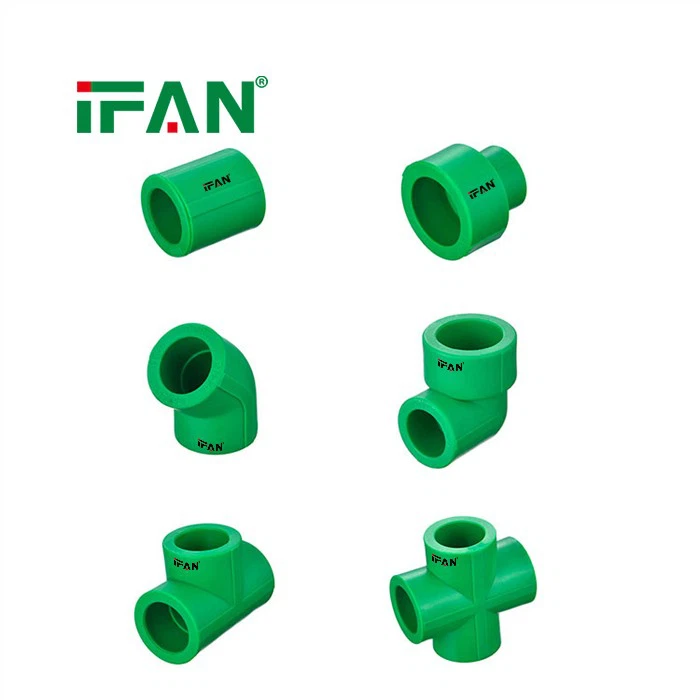

PPR Fitting For PPR Pipe
Why PPR Pipe Fittings Are Preferred for High-Temperature Plumbing Systems
Introduction: Meeting the Demands of Elevated Temperature Applications
High-temperature plumbing systems place continuous thermal stress on every component within the pipeline network. Domestic hot water circulation, radiant heating, and commercial boiler distribution systems require fittings that can maintain structural stability under sustained heat exposure.
PPR pipe fittings have become a widely adopted solution in such environments due to their balanced thermal resistance, pressure performance, and long-term durability. Their suitability is not based on a single characteristic but on the integration of polymer science, structural design, and reliable joint technology.

Thermal Resistance and Long-Term Heat Stability
The primary reason PPR pipe fittings perform well in high-temperature systems is the inherent thermal stability of polypropylene random copolymer. This material is engineered to withstand continuous operating temperatures commonly reaching 70°C and short-term peaks approaching 90–95°C under controlled pressure classes.
Unlike materials that degrade rapidly under prolonged heat exposure, PPR maintains molecular stability through optimized copolymer structure and thermal stabilizers. These additives slow oxidative degradation and preserve mechanical strength over extended service life.
Long-term hydrostatic testing confirms that PPR fittings retain pressure-bearing capability even after years of operation in heated water systems. This stability makes them suitable for both residential and commercial hot water distribution.
Controlled Thermal Expansion Compatibility
All materials expand when exposed to heat. In high-temperature plumbing, dimensional changes must be predictable and manageable. PPR pipe fittings are designed with a consistent coefficient of thermal expansion that matches PPR pipes.
Because both pipe and fitting share similar expansion characteristics, they expand and contract synchronously during heating and cooling cycles. This compatibility minimizes stress at the fusion joint and reduces the likelihood of distortion or leakage.
System designers can incorporate standard expansion allowances within pipeline layouts, ensuring that thermal movement remains controlled without compromising structural integrity.
Secure Fusion Joint Performance Under Heat
In elevated temperature environments, joint reliability is critical. Mechanical connections may loosen over time due to repeated expansion and contraction. PPR fittings, however, utilize heat fusion welding, creating a homogeneous molecular bond between pipe and fitting.
During installation, both components are heated to a specified temperature and then joined under controlled pressure. After cooling, the fused interface behaves as a continuous structure rather than a separate connection.
This integrated joint design ensures that high temperatures do not weaken the bond or create leakage paths. The absence of gaskets or threaded interfaces further enhances long-term stability under thermal stress.
Resistance to Scaling and Corrosion
High-temperature water can accelerate corrosion and scaling in certain piping materials. PPR pipe fittings offer inherent resistance to these issues because the polymer matrix is chemically inert in typical potable water conditions.
The smooth internal surface minimizes mineral deposit accumulation, maintaining stable flow efficiency over time. Without internal corrosion, wall thickness and structural strength remain unchanged throughout the service period.
This characteristic is particularly valuable in systems where hot water circulation operates continuously, as it supports both durability and energy efficiency.
Structural Strength Under Combined Thermal and Pressure Loads
High-temperature plumbing systems typically operate under pressure, meaning fittings must resist both thermal and mechanical stress simultaneously.
Modern PPR fittings are designed with optimized wall thickness and smooth geometry transitions to distribute load evenly. Finite element analysis and pressure regression testing validate performance under combined stress conditions.
By controlling stress concentration and minimizing residual internal stress during manufacturing, the fittings maintain dimensional stability even under prolonged exposure to elevated temperature and pressure cycles.

Conclusion: A Balanced Solution for Thermal Demands
PPR pipe fittings are preferred in high-temperature plumbing systems because they deliver comprehensive performance rather than isolated advantages. Their thermal stability, synchronized expansion behavior, fusion joint integrity, and corrosion resistance create a dependable solution for demanding environments.
Through careful material formulation and structural engineering, PPR fittings maintain pressure capacity and dimensional accuracy over extended service life. For modern heating and hot water applications, this combination of heat resistance and long-term reliability makes them a practical and efficient choice.
Hot Tags: ppr fitting for ppr pipe, China, suppliers, manufacturers, factory, wholesale, cheap, discount, low price, in stock, free sample, PPR Fitting Elbow, PPR Fitting Cap, Pure PPR Fitting, PPR Fitting Socket, PPR Fitting Tee, PPR Fitting Female
Send Inquiry
